
Searching Coshocton County Civil Dockets
Civil dockets in Coshocton County do not sit in one place. The Coshocton County Clerk of Courts Legal Office offers a records-search page. That page opens the Online Records System for General Division Civil and Domestic Relations cases. Coshocton Municipal Court keeps its own CaseLook search. It covers civil matters within that court's statutory jurisdiction. Probate cases, including estates, guardianships, and trusts, run through a separate Probate CaseLook route. Check the court named on your filing or notice first. That tells you which door to open.
Ohio has no single statewide case-docket tool that replaces these Coshocton County offices. When a record gives you a full case number, use it. A number beats a name for precision. The court does not publish its live Common Pleas field labels, result columns, or a local civil case-number pattern. Do not guess at any of them. If the court is unclear, call the clerk who holds the file, compare the caption and court on your paperwork, and treat any online result as a pointer to the case record rather than a certified copy.
- Match the Coshocton County matter to Common Pleas General Division, Domestic Relations, Municipal Court, or Probate Court.
- Open that Coshocton County court's official records channel and use the case number or other available case identifier.
- Check the displayed Coshocton County court, caption, filing date, and dated events before relying on a matching name.
- Read the newest Coshocton County order, motion, setting, or judgment event in the sequence shown.
- Request direct access or a copy from the Coshocton County custodian when an image, older file, or official certification is needed.
Coshocton County Civil Docket Court Routes
Where does a Coshocton County civil case land? That depends on the division and the type of matter, not one universal dollar shortcut. The Coshocton County Court of Common Pleas General Division serves as the general-jurisdiction venue. It handles complex and major civil litigation. Domestic Relations runs its own Coshocton County stream. It covers divorce, dissolution, legal separation, annulment, and post-decree support, custody, and parenting matters. Coshocton Municipal Court maintains a separate civil docket with local case-management rules. Estates, guardianships, trusts, and related probate functions belong to the Coshocton County Court of Common Pleas, Probate Division. The Coshocton County Common Pleas Court and the county court directory list these separate functions.
| Coshocton County civil venue | Coshocton County typical matter | Docket custodian |
|---|---|---|
| Coshocton County Common Pleas General Division | Complex or major civil litigation, judgment enforcement, and assigned appeals | Coshocton County Clerk Legal Office and Common Pleas records system |
| Coshocton County Common Pleas Domestic Relations | Divorce, dissolution, legal separation, annulment, and post-decree matters | Common Pleas and Clerk channel, subject to access limits |
| Coshocton Municipal Court | Civil actions within municipal statutory jurisdiction in Coshocton County | Municipal CaseLook and Municipal Clerk |
| Coshocton County Probate Division | Estates, guardianships, trusts, and marriage-related probate functions | Probate CaseLook and Coshocton County Probate Court |
Sort out the route before you search. That habit keeps a failed Common Pleas query from looking like a Coshocton County no-record result. It also steers a Coshocton County probate case away from the Municipal system and keeps a municipal civil matter out of a Common Pleas-only docket search.
Inside a Coshocton County Civil Docket
A Coshocton County civil docket, as the public interface shows it, is a chronological index. It tracks court activity in order. It can lead a reader to the case number, the court or division, the caption, the filing date, each dated entry, motions, orders, settings, and any recorded outcome. It does not promise a downloadable filing image, a financial balance field, or a certified copy of anything. The county posts no anonymous sample civil record. It posts no published local disposition-code list either. So the terms here describe what court records generally do. They do not describe a confirmed Coshocton County interface.
| Case number | The Coshocton County court's unique case identifier. Preserve the actual number rather than assuming a local civil prefix. |
|---|---|
| Caption and court | Identifies the Coshocton County case and the custodian or division that holds its file. |
| Filing or event | A dated Coshocton County record of a pleading, notice, motion, order, or other court action. |
| Setting | A listed Coshocton County hearing or court event that may need current confirmation from the owning court. |
| Judgment or disposition | A recorded Coshocton County order, dismissal, judgment entry, or other procedural outcome as the record states it. |
Carry two details into any focused Coshocton County case lookup: the case number and the current court. Together they let you verify a filing route without guesswork. A docket result here points you to the court file itself. The clerk's office stays the source for any permitted official copy, so treat the online entry as a pointer rather than the final record.
Coshocton County Civil Docket Historic Indexes
Civil matters from earlier eras take a different path in Coshocton County. According to the Clerk, electronic Common Pleas records reach back only to January 1, 1999. That applies unless a case was later reopened. Before that, you work from historic civil index collections. They cover 1811–1968, 1958–1992, and 1993–1999. Those ranges overlap on purpose. They are finding aids. They are not proof that an old paper file or document image sits online. The Clerk states plainly that historic case images are not available through the posted indexes. The office also does not perform genealogy research.
The Coshocton County court's courthouse history records that county documents date to 1811. It ties that long paper trail to the courthouse still standing today. For a pre-electronic civil file, the practical order is simple. Pull the relevant historic index first. Note the case or volume details it gives you. Then contact the Clerk Legal Office about inspection or copies. A portal search alone cannot carry an older matter that falls outside the stated online coverage.
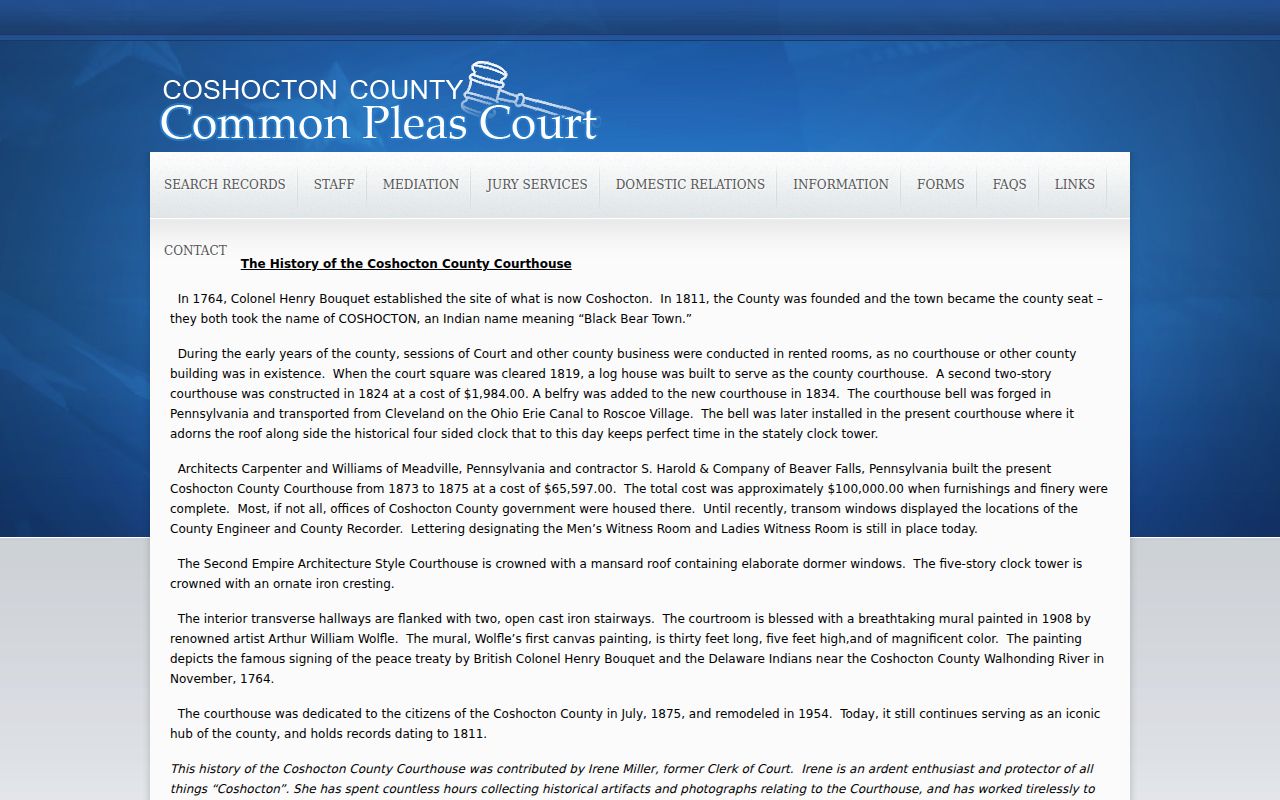
That courthouse history explains why an old Coshocton County civil docket often ends at a physical index and a clerk inquiry. Instant document downloads are simply not part of the picture for the earliest years.
Civil Case Types on the Docket
A civil label alone tells you little. The real information sits in which Coshocton County court holds the docket. Common Pleas General Division handles complex or major civil litigation along with post-judgment activity. Domestic Relations records sit apart. Even so, the Clerk includes that division in its electronic-record scope. Coshocton Municipal Court runs its own civil record channel. Probate cases, covering estates, guardianships, trusts, and similar functions, come from a different court entirely. Match the docket to the court with authority over the specific matter. The right records follow.
- Coshocton County General Division civil litigation and judgment-enforcement activity.
- Coshocton County Domestic Relations divorce, dissolution, separation, annulment, and post-decree matters.
- Coshocton Municipal Court civil actions within that court's statutory jurisdiction.
- Coshocton County Probate estates, guardianships, trusts, and related proceedings.
- Coshocton County appeal-related events that may leave the trial docket for a separate appellate record.
The Fifth District Court of Appeals keeps the appeal itself. A notice of appeal may still show up in the originating Coshocton County civil docket, but that entry only marks the start. The appellate docket is the record that follows the case once it moves up, so the two serve different purposes for anyone tracing a matter.
Coshocton County Civil Docket Image Boundary
Online images through Coshocton County Common Pleas generally cover eligible documents filed on or after November 1, 2019. That date is a boundary. It is not a guarantee. An entry can list a motion, order, or judgment while the underlying item stays off the public screen, since Ohio access law permits restrictions. When an image is missing, the Coshocton County Clerk still handles copy requests and inspection where access is allowed.
Attorney e-filing is a separate lane entirely. The Clerk's e-filing instructions walk lawyers through an attorney account, case-type and initiating-action choices, document uploads, payment, and fixing rejected filings. Pro se litigants do not use that attorney service. A brand-new filing may also sit awaiting review. Filing activity does not mean an image is public yet.
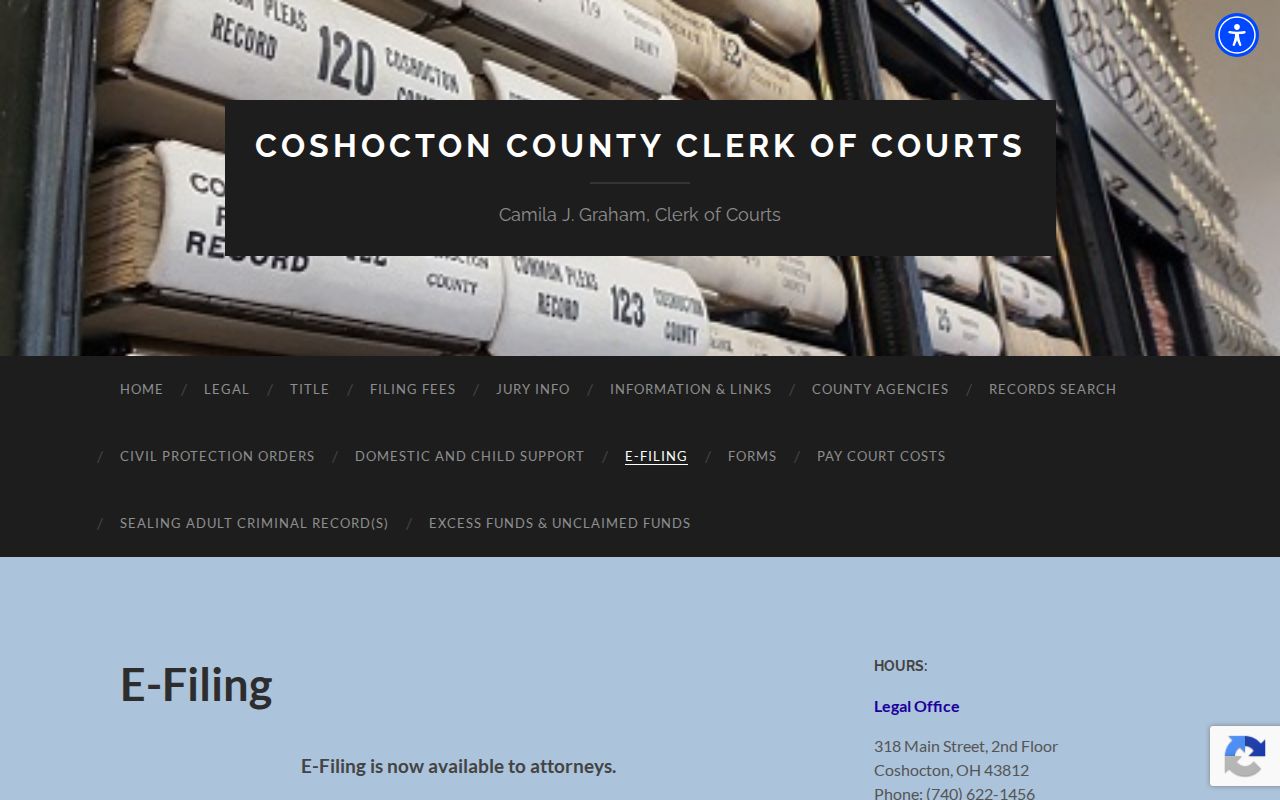
The Clerk's filing workflow explains recent activity in a Coshocton County case, but the public docket remains the separate record-search channel.
Note: Coshocton County e-filing serves attorneys filing documents, while public case access runs through the separate records-search route.
Civil Docket Settings and Hearings
A civil setting on a Coshocton County docket is a scheduled event, not an outcome. Entries can include hearing notices, motion dates, conferences, continuances, orders, and judgment entries. The newest relevant entry gives the current setting. Coshocton Municipal Court posts its own monthly calendar, filterable by Month, Year, and Attorney. Municipal electronic records refresh every 24 hours. A near-term hearing deserves a call to the court when the calendar and the record disagree.
Common Pleas offers no separate public daily-calendar interface. For a pending Common Pleas civil file, start with the Clerk's record channel. Read the newest events, and treat the Clerk or Court as the confirmation path. Municipal local rules set out a civil case-management system too. But never assume a hearing date from an old filing notice. The Coshocton County Court Dates resource lays out court-specific confirmation routes in more detail.
Coshocton County Civil Docket Copy Requests
The Coshocton County Clerk's fee schedule draws a useful line for civil records. Plain copies run $0.25 per page. A certified document copy costs $1.00 under the posted Common Pleas rates. Confirm the certification figure for your request, including whether it stacks on top of copying. The schedule also lists certificate-of-judgment, execution-on-judgment, garnishment, writ-of-possession, and reopening-case categories. Those are fee categories only. None of them promises a public docket image for every event or document.
| Common Pleas civil request | Published amount |
|---|---|
| Plain copy | $0.25 per page |
| Certified document copy | $1.00, with the specific total confirmed by the Clerk |
| Certificate of judgment, make | $5.00 |
| Certificate of judgment, file | $30.00 |
| Certificate of judgment, make and file | $35.00 |
When a Coshocton County docket names a motion, judgment, or order you need but shows no image, ask the court that owns the document. Municipal and Probate records sit with their own clerks and their own request paths, so the Common Pleas figures do not travel with them. Fees differ by court.
Note: Confirm the Coshocton County court's current total before paying, because one copy request can carry more than a single charge.
Civil Docket Access Rules
Ohio's court-access rules generally open Coshocton County civil court records to the public. The reach has limits, though. The Common Pleas Clerk says its search covers Civil and Domestic Relations records. It excludes domestic-violence cases from public online search. Ohio law does not require remote general-docket access for domestic-relations or juvenile cases, and protected personal identifiers or restricted documents may drop out of a public result. A courthouse request or public-records process cannot override a sealing order, Rule 45 restriction, or statutory protection.
Key Rules:
Ohio Superintendence Rule 45 - Court records are presumed open, subject to access restrictions and reasonable request procedures.
Ohio Revised Code 2303.12 - The Common Pleas Clerk keeps court records and the statute addresses public remote access.
Ohio Revised Code 2303.901 - Dockets and filed documents must protect personal identifiers and identified restricted material.
Ohio Revised Code 149.43 - Ohio's Public Records Act provides the broader public-records framework, subject to court-record rules and exemptions.
The official Common Pleas records statute frames the Clerk's custody and remote-access role.
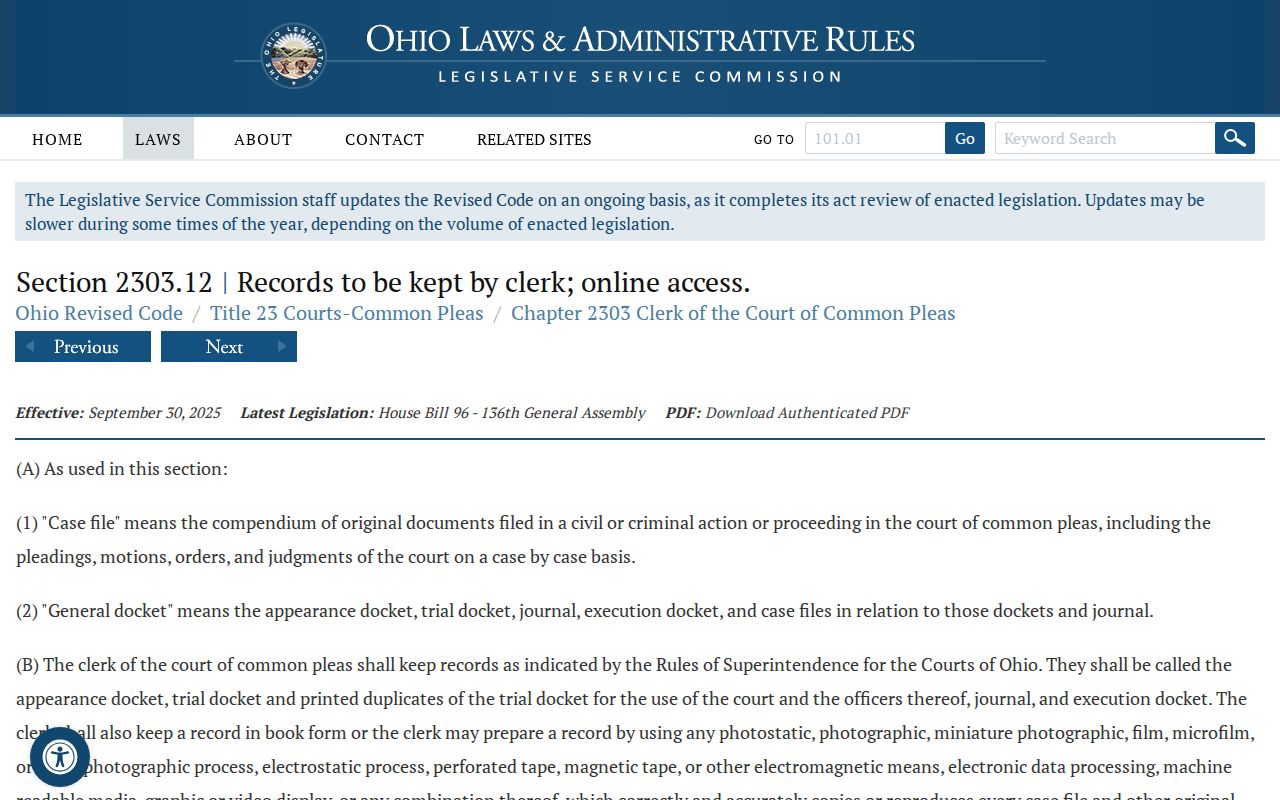
That framework keeps Coshocton County records open while holding protected material outside the public docket view. Access rules do not close the docket; they trim what appears in it.
The official personal-identifier statute sets out why sensitive information may be missing from public case material.
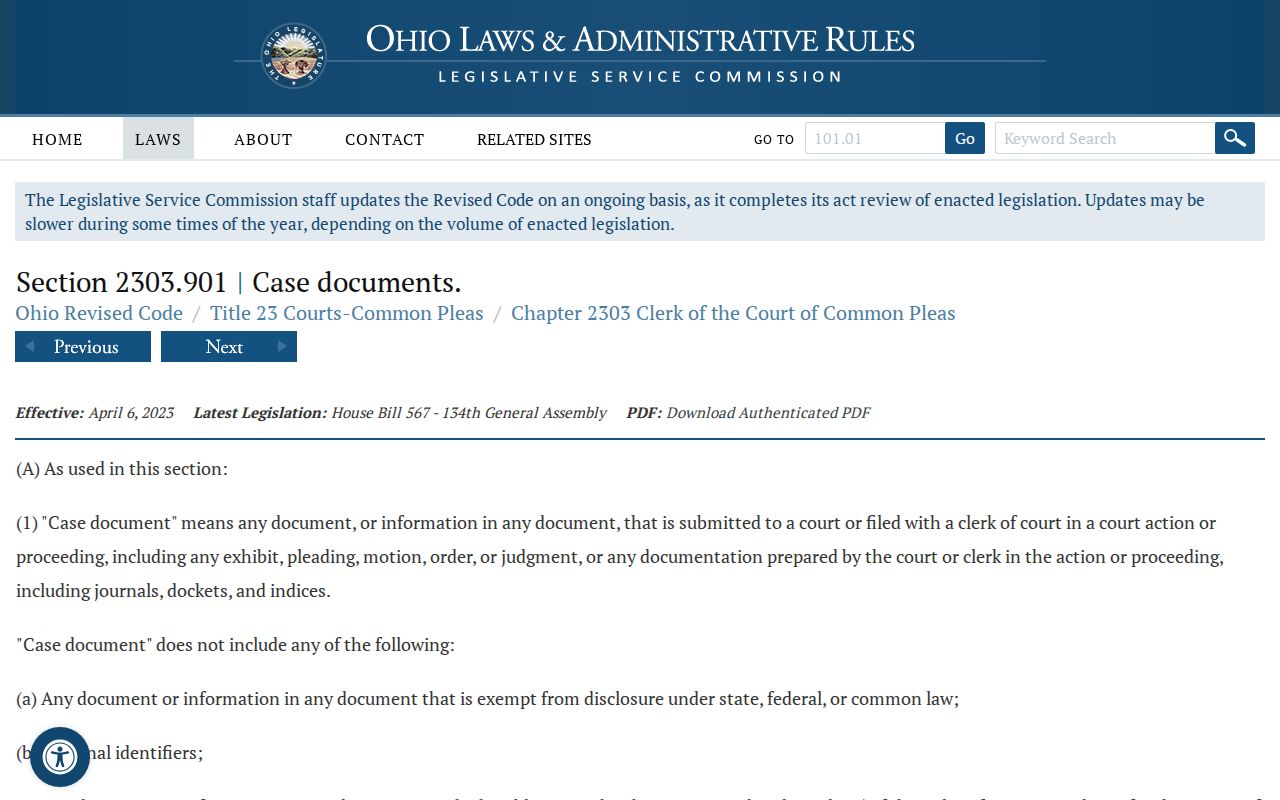
Redaction and access limits protect information in Coshocton County. They do not turn every Coshocton County civil docket into a closed record.
Coshocton County Civil Docket Documents
Three record layers sit behind any Coshocton County civil case. The docket is the first one. It finds the case and tracks each event as a docket entry. Behind an entry sits the filed document itself, a motion, pleading, order, or judgment. Public access and image availability decide whether you can open it. Then there is the certified copy. Only the office that keeps the record can certify one. It must be requested there. Printing a page from a public portal gives you none of that standing.
Work the courts in Coshocton County one at a time. Start with the online record for a Common Pleas matter. Pin down the case number and the exact document or event you need, then ask the Coshocton County Clerk Legal Office for the permitted item or a certification. Probate and Juvenile run their own request process for Coshocton County matters. Extra access limits can apply. A Coshocton Municipal Court civil record goes to the Municipal Clerk, not to Common Pleas. Keep each court docket request pointed at the right office. That preserves the line between a public index and the full case file.
A request works best when it is precise. Give the clerk the case number, court name, date, and a plain description of the document. That beats asking for every record in the file.